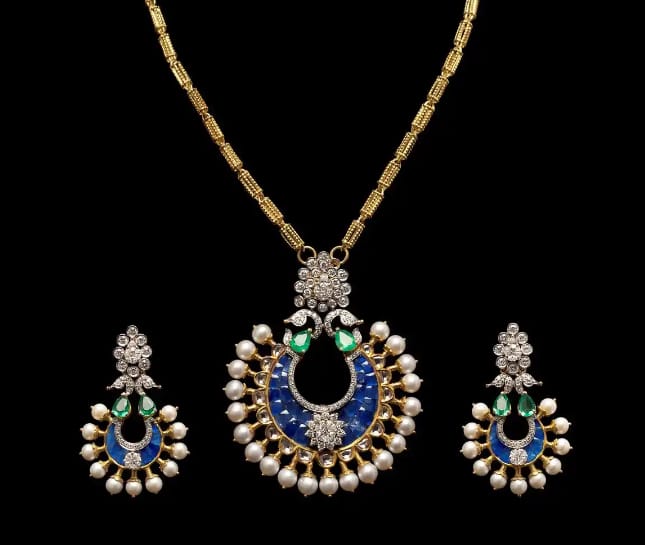
For women, jewelry is indispensable—a symbol of femininity that embodies metaphors of enduring love. We cherish jewelry for the way it enhances the perfection of romance; it represents a beauty that is immediately apparent. We know that jewelry possesses a certain “spirit” or allure, but how much do you actually know about it? Here, Zhoubaifu Jewelry offers a comprehensive guide to the basics of jewelry, helping you gain a better understanding.
1. Diamonds
Diamonds are crystalline minerals formed from a single element—carbon—under unique environmental conditions. Gem-quality diamonds are prized for their extreme hardness, exceptional abrasion resistance, and chemical stability. They possess a brilliant luster that withstands wear and tear, maintaining a lasting, adamantine shine. Furthermore, diamonds have a high refractive index (2.42) and strong dispersion (0.044—the highest among natural colorless gemstones). When faceted, white light entering the diamond is dispersed into spectral colors, creating a dazzling, rainbow-like brilliance and a sparkling, water-clear optical effect.
2. “Gold Jewelry” and “Platinum Jewelry”
Any jewelry crafted entirely or partially from gold is classified as “gold jewelry,” whereas jewelry made from the precious metal platinum is known as “platinum jewelry.” Because platinum is more sparsely distributed in the Earth’s crust and more difficult to extract than gold, platinum jewelry generally commands a higher price.
3. “K-Gold”
Pure gold is naturally very soft, making it difficult to craft into intricate designs or securely set precious stones like pearls, gems, and jade (which risk falling out). Consequently, since ancient times, small amounts of metals such as silver, copper, and zinc have been added to pure gold to enhance its strength and durability. Gold jewelry created in this manner is known as “K-gold.” 4. Ruby and Sapphire
Exquisite color and transparency are hallmarks of rubies and sapphires. Both are composed of aluminum oxide; while pure specimens are colorless, the presence of trace amounts of coloring ions produces various hues—for instance, chromium yields red (ruby), while titanium and iron yield blue (sapphire). Both gems range from transparent to translucent and exhibit a vitreous luster. They display distinct pleochroism under a dichroscope, possess a hardness of 9 and a specific gravity of 4, and feature conchoidal fractures with no cleavage. Under ultraviolet light, rubies exhibit distinct red fluorescence, whereas sapphires—with the exception of certain varieties from Sri Lanka and Kashmir—do not fluoresce.