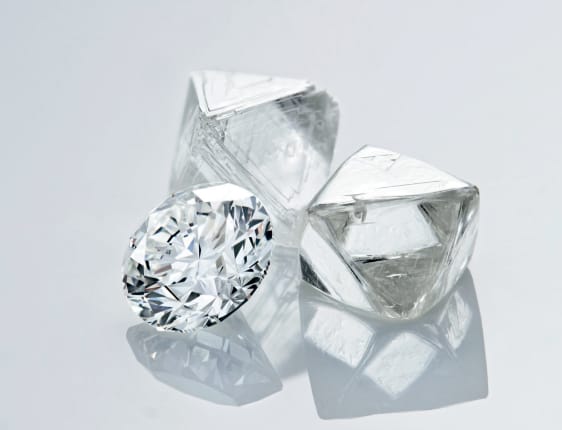
In the jewelry world, distinguishing between the real and the fake can be difficult, especially with so-called “genuine natural diamonds” marketed at low prices. How can you avoid falling into these consumer traps? The following five identification methods will help you spot diamonds that are obviously fake at a glance.
Tip 1: Observe the Luster
Natural diamonds possess a distinctive “adamantine” (diamond-like) luster; those familiar with natural diamonds can often tell the real thing from the fake simply by looking at this shine.
Tip 2: Check for Imperfections
During their formation, natural diamonds inevitably develop imperfections such as inclusions or internal fractures. These flaws are hallmarks of natural diamonds and serve as key indicators of authenticity. If a diamond appears perfectly clean inside without any flaws, it is likely man-made.
Tip 3: Examine the Color
Natural diamonds come in a variety of colors—ranging from colorless to yellow or brown—as well as rare, expensive fancy colors like pink, blue, and green. Their color is usually uneven, showing variations in depth due to slight color shifts or inclusions. In contrast, diamond simulants often display very uniform color that lacks depth or nuance; colored simulants often look overly vivid or unnatural. Therefore, when shopping, carefully observe whether the color looks natural and possesses depth.
Tip 4: Observe the Fire (Dispersion)
“Fire” refers to the flashes of spectral color emitted from the surface of transparent, colorless, or light-colored faceted natural diamonds. The intensity of this fire varies by diamond type. Genuine natural diamonds exhibit high luster and distinct brilliance. Additionally, the fire in natural diamonds tends to feature blue and orange tones, appearing both dazzling and sharp.
Tip 5: Pay Attention to Size
Most high-value natural diamonds are not excessively large. When shopping for jewelry, exercise extra caution if you encounter a “natural diamond” of unusual size—especially one claimed to be a rare variety—as it is highly likely to be a fake or an artificially treated, inferior product.
Always remain vigilant when purchasing natural diamonds. While value for money is important, deals that seem too good to be true—defying standard market norms—often carry the risk of fraud or deception. Furthermore, the testing of natural diamonds requires a high level of professional expertise; consumers can rely on the National Gemstone Testing Center (NGTC), whose professional assessments ensure that counterfeit diamonds have nowhere to hide, helping you purchase jewelry with confidence and peace of mind.